
A Comprehensive Guide to Puppy Biting Training OKC
Puppy biting training OKC starts with a structured plan that builds bite inhibition and keeps you in control on your own floor plan. Reward-based, science-backed methods help your young dog learn boundaries safely without physical corrections. You gain long-term stability when you take tactical control of daily interactions and give immediate environmental feedback.
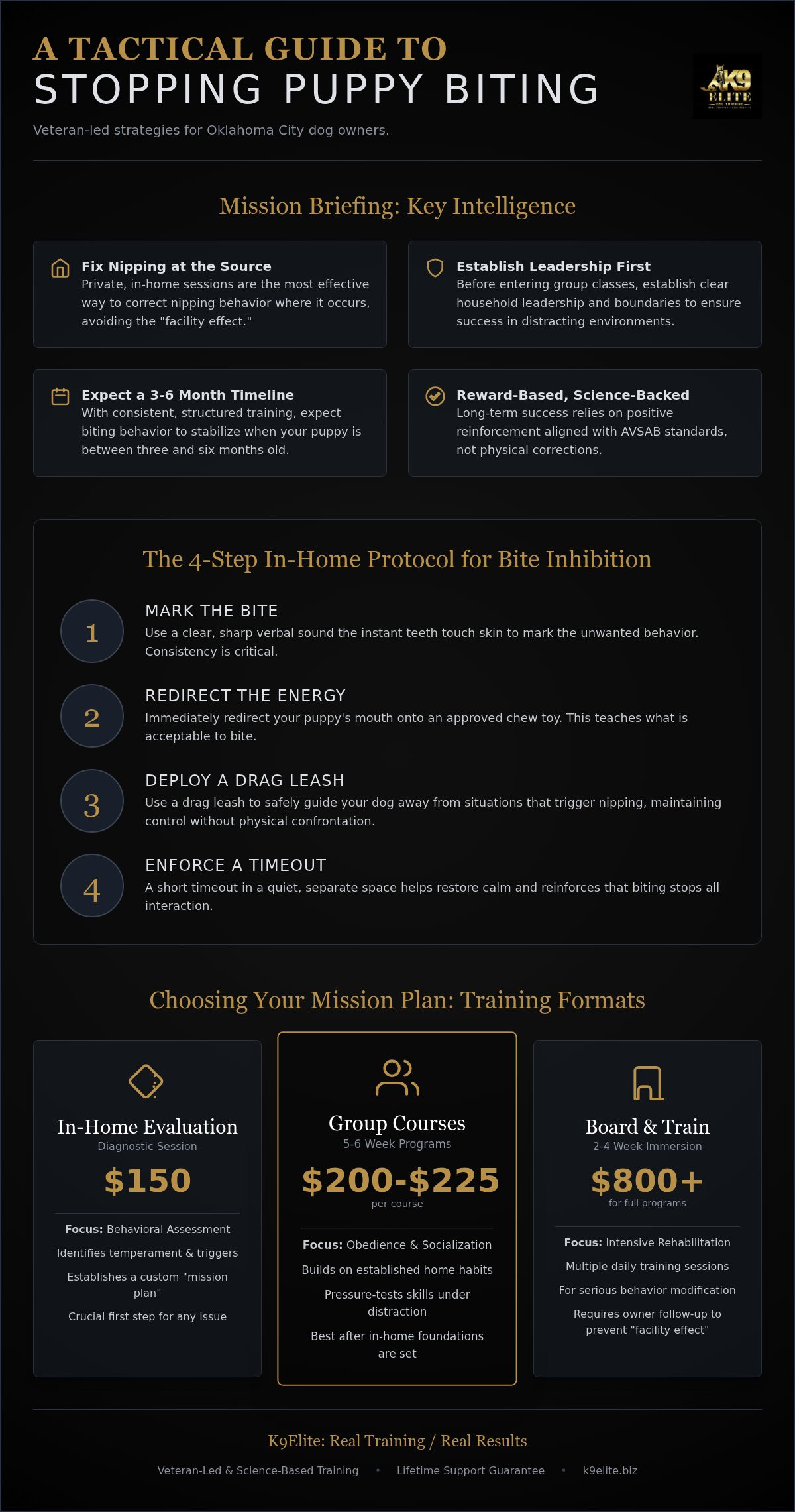
Key Takeaways: Stop puppy biting in Oklahoma City by using reward-based redirection and in-home private sessions to establish bite inhibition before entering group classes.
Typical market pricing for basic training in OKC ranges between $90 and $149.
Expect results to stabilize between three and six months of age with consistency.
Private in-home sessions are best for fixing nipping where it actually occurs.
Unless you establish household leadership, board and train programs often create facility-only fixes.
Table of Contents
Puppy biting training OKC: 3 ways to stop nipping that fit your needs
You can stop puppy nipping with a mission plan matched to your household, not a one-size routine. With clients we see that early structure cuts off mouthy behavior before it hardens into bite habituation.
Two or three scenes show up again and again:
Play in the living room ends with tooth marks on your hands: put a drag leash on and redirect so physical boundaries stay clear in the moment.
Short practice at home is not sticking: add balanced group work built on the ANCHOR System so foundation habits get drilled under guided repetition.
Nipping flares at doorways, around kids, or near specific furniture: schedule in-home training so you correct the pattern in the rooms where it starts.
In-home work lets you handle those patterns where they happen and skip facility-only fixes that fade after you drive home. Household consistency is what holds the gains once the session ends.
Positive reinforcement teaches bite inhibition without force
Positive reinforcement stops puppy biting by teaching bite inhibition through structured reward systems instead of physical force. Long-term success relies on reward-based techniques aligned with the AVSAB standard.
In field operations, our veteran-led approach uses precise timing to mark correct behaviors. Science-backed protocols protect your hands while building emotional control in your young dog.
Proper puppy training guidance needs high consistency in daily interaction. We enforce calm leadership so reliable habits form without aggressive confrontation.
Structured drills set healthy boundaries early. When teeth touch skin, mark the moment, redirect, and repeat the standard in your Oklahoma City home until the pattern holds.
Tip: Redirect mouthy puppies onto an approved chew toy immediately when teeth make contact with human skin.
What investment should families expect for professional training services?
Professional program costs vary across Oklahoma City based on curriculum depth, program length, and the instruction format you choose. Compare service scope, not only the first number on a flyer. Group classes offer lower entry points, while board and train options require higher financial commitments of $300, because of intensive daily care.
Home bites often continue after facility-based group sessions because the context never matched your living room. Work those patterns through direct puppy programs so leadership sticks on your home field. Private instruction functions as a targeted mission that treats mouthiness in the exact space where it shows up.
According to local market data samples, local training programs generally fit a $90–$149 market price band. Structured leadership over short-term patches saves you time and stress. Request a personalized quote for exact figures.
Fix home nipping before you enter group classes
Private home sessions give you the clarity to stop biting before you add group distraction.
When your hands are covered in scratches after play that went wrong, the problem is rarely effort alone: home boundaries stayed chaotic while you hoped a busy class would clean up mouthing by itself. From field operations we see puppies fail in groups when those local rules never got set. Action that fits the facts: start with private in-home work that marks bites, redirects to an approved toy, and uses a drag leash in the rooms where nipping starts. Outcome: once those patterns stabilize, group work can pressure-test obedience instead of putting an unprepared puppy into repeated failure.
We favor initial private sessions because household mouthing patterns are mission-critical. In-home training in OKC treats those patterns on site and avoids temporary facility-only fixes, though it does not supply heavy early distraction on its own.
After home structure holds, group classes operate as a field exercise under pressure. Group work suits stable dogs; private instruction repairs structural gaps at home.
Our write-up on five bite-stopping methods shows how structured discipline builds clear communication. Set your parameters, then run the plan each day.
4-Step protocol that builds in-home bite inhibition
Run a clear protocol inside your Oklahoma City residence when puppy mouthiness turns sharp. Veteran-led experience shows that correcting unwanted mouthing at home blocks longer-term issues before they set.
Mark the bite with a clear verbal sound the second teeth touch skin.
Redirect the energy onto an approved toy to set strong boundaries.
Deploy a drag leash to guide your dog away from the rooms and moments that spark nipping, so home-field work treats the issue locally and avoids the facility effect of center-only fixes.
Enforce a short timeout in a quiet room to restore calm and balance.
Household leadership depends on consistency in each engagement. You strengthen that leadership when you run this sequence daily.
Verify trainer credentials before you commit
The Oklahoma City market lacks standardized trainer qualifications, so unverified claims appear often among local class providers. Evaluate credentials before you commit your dog to a plan.
Unverified certifications can hide a thin methodology. Hiring a trainer without clear standards is like entering a tactical operation without a map. Ask for a written outline of the balanced approach before you sign.
Marine Corps veteran Coty Cortez established K9Elite to pursue mission success with a science-based, balanced approach. That veteran-led structure gives you clear leadership and precise instruction so you can manage nipping in ordinary daily routines. Home work avoids temporary patches; center-only work can still produce a facility effect when behavior reverts outside the building.
Verify veteran provenance and science-backed protocols so you know the structure you are buying.
When board and train programs leave gaps at home
Sending a biting young dog to an offsite facility often fails to solve household issues. The pitch is simple: send your dog away for a few weeks, get back a trained one. Puppies still hit the facility effect (learning to obey in a controlled center while chaos returns at home).
From field operations, young dogs respect the rules of the place where they actually live. Pulling the animal out of that environment leaves gaps in your daily routine. Nipping forms around your furniture, family members, and specific Oklahoma City spaces a kennel cannot copy.
Establish leadership in your own living space if you want control that lasts. In-home instruction builds your authority where you still have to live with the dog.
Meet OKC health rules before group exposure
Oklahoma City regulations require all dogs to have a current rabies vaccination before entering group settings.
Field observations show that skipped health checks create vulnerabilities across a puppy cohort. Verified immunity is your defensive perimeter before group exposure. Most local facilities mandate proof of Parvovirus, Distemper, and Bordetella shots alongside local licensing.
Secure health clearances before group work. Early classes depend on that compliance to protect each dog in the room.
Group rooms still carry risk. The facility effect (strong behavior in a center that falls apart at home) can limit how far outdoor progress carries. Balance early socialization against pathogen contact. An in-home evaluation flags issues before you deploy into a group.
K9Elite enforces strict entry protocols for cohort safety. Confirm records before you enroll.
Details and enquiries: K9Elite.
Frequently asked questions
What is the best training to stop a puppy from biting?
Structured consistency stops mouthing fast. Redirect your dog to an approved toy as soon as teeth touch skin. Reward-based methods, the AVSAB standard, produce reliable long-term results when you pair them with steady leadership.
What age do puppies learn not to bite?
Puppies usually gain bite inhibition between three and six months of age. Steady use of bite-inhibition protocols speeds that timeline when you hold the same standard every day.
When should I consider private dog training?
Seek a professional evaluation when bite behavior turns aggressive or ignores basic corrections. In-home evaluation sessions treat issues on your home turf and aim at the rooms where trouble starts. Private in-home work can still feed a facility effect if you never practice outside the living room.
Where can I train my puppy in OKC?
You can access structured programs across the Oklahoma City metro area. K9Elite provides veteran-led instruction so your dog builds disciplined habits while you run daily drills in more than one setting.
What programs help prevent dog bites?
Early obedience programs teach social boundaries to young dogs. Structured courses establish control and operational focus while the dog


Comments