
K9 Protection Training Oklahoma City: Functional Safety
K9 protection training Oklahoma City equips you with structured defensive capabilities when you need reliable security for your household. Market research shows that an initial professional evaluation in the region averages around $100, while full protection training programs across Oklahoma City typically range from several hundred to thousands of dollars depending on the scope. Establishing clear handler leadership ensures your dog performs defensive tasks reliably under extreme stress without compromising household safety.
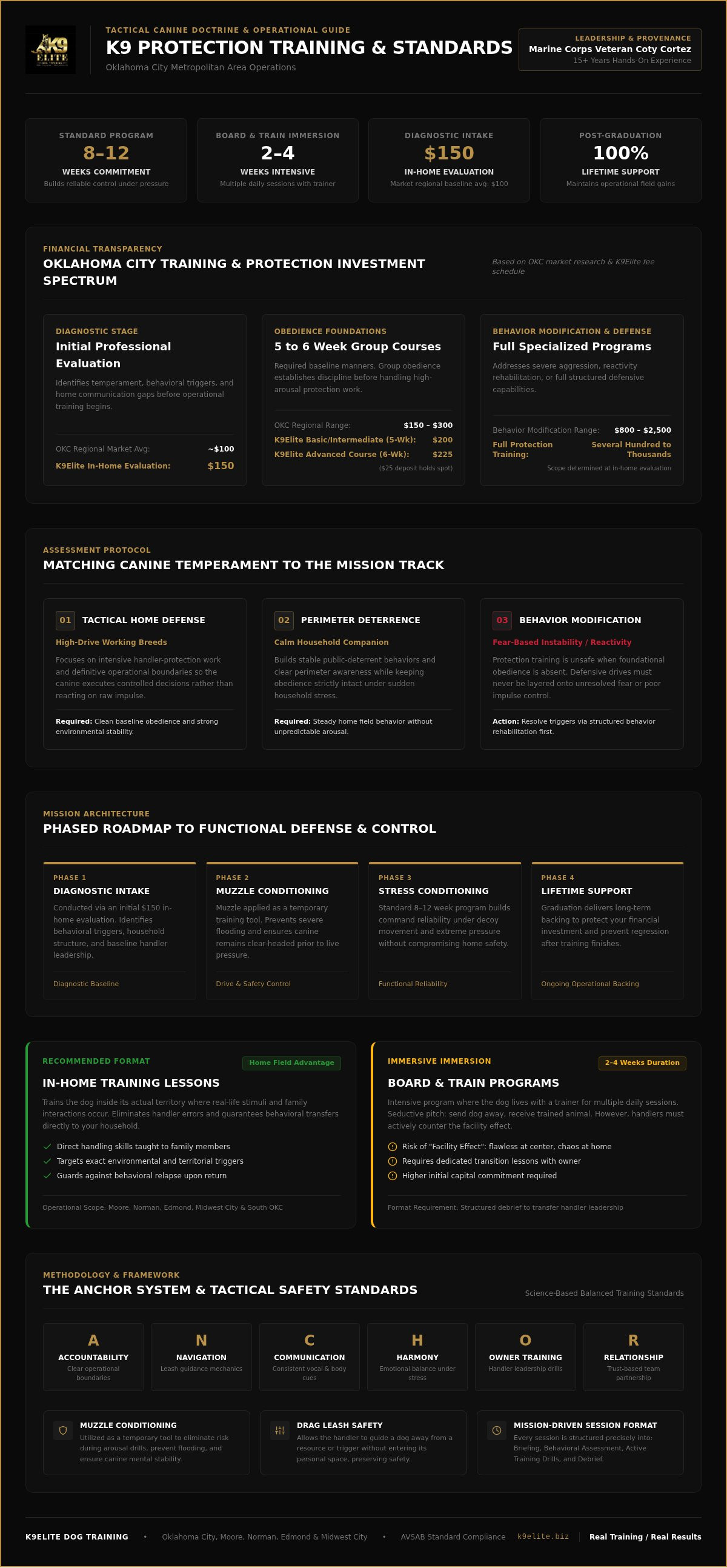
Key Takeaways: K9 protection training in Oklahoma City typically costs several hundred to thousands of dollars and requires an 8 to 12 week commitment for reliability.
Initial professional evaluations in the Oklahoma City market average approximately $100 before program enrollment.
Except when a dog lacks foundational obedience or shows fear-based instability, protection work is unsafe.
Choose in-home lessons over board and train to ensure skills transfer to your household.
Programs include lifetime support to protect your investment and maintain operational gains after graduation.
Table of contents
Choosing the Right Track for K9 Protection Training Oklahoma City
Selecting the proper protection training (personal protection) track starts with your home environment, your security goals, and your dog’s temperament. Before you commit capital, match your situation to a concrete path:
You want tactical home defense with a high-drive working breed: prioritize intensive handler-protection work and clear operational boundaries so the dog learns control rather than uncontrolled impulse.
You need calm perimeter deterrence with a quiet household companion: focus on stable public-deterrent skills and early diagnostic checks that keep obedience intact under stress.
You are still unsure whether protection belongs on your plan at all: begin with a professional evaluation and foundational obedience so you do not layer defensive drives onto unresolved fear or poor impulse control.
With clients we see that handling tactical home defense differs sharply from public deterrent work. A tactical mission plan teaches your dog control you can trust when pressure rises. You can weigh family goals through personal and family protection options and build a stable defense team from that baseline.
Our veteran-led methodology uses science-based, balanced training to instill discipline you can reproduce at home. Early diagnostic checks prevent behavioral triggers from disrupting obedience when the environment turns loud or unpredictable. Structured leadership on your side of the leash is what keeps household safety intact while defensive tasks stay reliable.
What Drives the Cost of Protection Dog Training
Protection training pricing structures in Oklahoma City often lack public transparency, so you will need direct consultation for exact custom quotes. Entry-level figures from market research appear in the opening above; full program cost still depends on scope, and facilities frequently withhold a complete fee picture until you visit in person.
| Program Component | Cost Driver | OKC Market Transparency | |:--- |:--- |:--- | | Initial Assessment | Behavioral analysis | Variable pricing | | Program Scope | Foundation to advanced | Direct quote needed |
That gap leaves handler budgets exposed to surprise line items. Evaluating a tactical canine program works best when financial terms sit on the table before you commit heavy capital. An in-home assessment in OKC gives you baseline data and direct operational visibility first. Science-based methods still require clear structure for both handler and dog. More on this: In-Home Dog Training in Oklahoma.
Serious behavior modification work ranges widely across local programs depending on scope and severity. Defining your mission parameters up front is how you keep spending predictable.
Tip: Request a full cost breakdown during your initial professional evaluation to avoid unexpected fees.
Why Trainer Credentials Shape Reliable Outcomes
Vetting a handler means checking background, tactical field experience, and real-world working dog methodology. You need an instructor who can hold drive control when pressure spikes, not only when the room is quiet.
Marine Corps veteran Coty Cortez established K9Elite, which remains dedicated to mission success through a science-based, balanced approach. Military-led precision gives your dog clear structure, consistent boundaries, and reliable command execution. Our handlers bring over 15 years of hands-on training experience to each session. Choosing guided protection work in OKC builds functional bite work without sacrificing environmental stability.
One detail handlers often skip: tactical instructors condition dogs to working muzzles before high-arousal protection work. Proper muzzle conditioning prevents severe flooding and keeps the canine clear-headed in complex threat scenarios. Treat the sequence like basic marksmanship practice: master stance, control, and breath discipline before you introduce live pressure.
If your dog shows unpredictable reactivity, select a structured behavior modification path; if baseline manners are already clean, standard obedience may be enough to start. Our team relies on a proven ANCHOR System to maintain emotional balance and clear communication between you and your dog. Inspect credentials, field history, and methodology before you sign.
Program Timelines That Build Control Under Stress
A complete protection training program typically requires an 8–12 week commitment to establish reliable control.
In our tactical work, working-dog discipline needs daily consistency before you advance into complex defensive scenarios. Foundation work locks in control under stress so baseline habits do not collapse when the decoy moves or the environment changes. Owners who still need that foundation should begin with obedience training in OKC and establish clear handler leadership first.
For full working capability, board and train programs offer intensive immersion lasting two to four weeks. In that window, dogs complete multiple daily sessions designed to reduce handler errors and stabilize responses across environments.
The standard timeline breaks into structured operational phases:
Initial diagnostic evaluation to map temperaments and behavioral triggers
Core leash navigation and obedience work
Controlled scenario work with precise decoys
Realistic threat management needs repetitive, science-based conditioning over several months rather than a single compressed weekend. Dedicated repetition is what makes control hold when you leave the training yard.
5 Steps That Produce Functional Protection
Building reliable protection training follows a mission-driven structure that advances through tactical stages only after control is proven.
Conduct professional evaluation: Assess behavioral triggers and environmental stability through an in-home dog training evaluation OKC.
Establish structured obedience: Master foundational commands so you retain control before controlled defensive pressure begins.
Introduce bite mechanics: Teach targeted grip work using science-based balanced training methods.
Apply tactical stress: Expose your dog to dynamic environments without provoking high reactivity or emotional shutdown.
Execute mission debrief: Review handler actions so long-term control and safety stay intact after the program ends.
Situation: you need defensive capability but still lack clean obedience on leash. Solution: run steps 1–2 until commands hold under mild distraction, then open bite mechanics. Result: you progress into stress drills with a dog that can still hear you, which is the difference between controlled work and liability.
Structured methodology builds emotional stability you can measure in daily life, from doorway greetings to public sidewalks.
Ready to map these steps onto your dog? Ask us for a tailored evaluation plan.
In-Home Lessons Compared With Board and Train
Choosing in-home lessons builds real-life handling skills on the terrain where you actually live and walk your dog.
Board and train programs offer intensive immersion where a dog lives with a trainer for two to four weeks. Sending a dog away still carries a real risk of the facility effect: skills look sharp on campus and fade in your kitchen. Your household is the home field where specific behavioral triggers show up, so private in-home sessions keep you inside the learning loop. Progress that lasts requires your hands on the leash in the dog’s living environment, not only a temporary proxy handler.
Dogs often struggle to transfer obedience from an isolated facility back into a busy living room. Our science-based, balanced approach uses reward-based methods consistent with American Veterinary Society of Animal Behavior (AVSAB) guidance on positive reinforcement, paired with clear structure so you retain accountability and long-term reliability. Private lessons fit owners who want direct command over the personal protection (protection training) process; away programs fit owners who need temporary off-site conditioning and accept a heavier transfer burden afterward.
Run daily field drills with a drag leash to enforce boundaries safely without crowding the dog’s space. That habit keeps communication clear once formal lessons end.
When Protection Training Is the Wrong Choice
Protection training is dangerous for dogs with unstable temperaments or unaddressed fear issues. Building defensive drives on top of poor impulse control creates severe liability for you and the public.
From client work we see a repeating arc. Situation: a handler reads fear-based aggression as “natural protection” and asks for bite work first. Solution: stop the protection track, run a professional evaluation, and install standard obedience plus behavior modification until nerve strength and impulse control stabilize. Result: you avoid unpredictable biting tied to anxiety and only reopen tactical work when structural balance is measurable.
Unstable candidates need that foundation before tactical drills begin. Diagnostic assessment is how you identify underlying triggers; market entry pricing for evaluations is outlined in the introduction, while full behavior modification cost still varies by scope. Standard obedience must precede specialized instruction.
If your dog lacks basic discipline, personal protection will compromise public safety rather than improve it. Owners who need stability first should stay on foundational obedience. K9Elite evaluates candidate dogs through a professional evaluation that measures structural balance and nerve strength before any protection track is approved.
Tactical stress applied too early escalates underlying fear into dangerous panic, so confidence is not something bite work creates on top of unresolved anxiety.
Frequently asked questions
How much is it to train your dog for protection?
Professional protection training pricing varies by your dog’s evaluation and by whether you choose board and train or private lessons. Entry assessment figures from market research are noted in the introduction; your total investment follows the scope you select after that baseline. Founded by Marine Corps veteran Coty Cortez, K9Elite delivers structured mission plans tailored to your defensive goals. Submit a request for a personalized quote to establish your dog’s tactical roadmap.
How does private training work?
Private instruction delivers targeted, one-on-one coaching inside your home so you keep home-field advantage. We run a systematic mission-driven structure that starts with an initial briefing, moves into active tactical drills, and finishes with a debrief. That setup addresses real-world behavioral triggers where they occur. You master clear handler commands while your dog builds structured stability you can rehearse between visits.
What behavioral issues can be fixed?
Handler-focused rehabilitation protocols can modify severe aggression, reactive lunging, and chaotic home behaviors. The work targets root causes of distress rather than temporary patches. You establish reliable boundaries that reduce territorial guarding and unsafe outdoor responses, restoring order you can live with day to day.
What is the training methodology?
Reward-based methods aligned with American Veterinary Society of Animal Behavior (AVSAB) guidance anchor the teaching loop. Alongside that reinforcement work, we apply structured accountability inside a balanced framework so compliance stays consistent under pressure. This science-based strategy protects your dog’s emotional stability while you hold clear leadership, which is what keeps performance safe when the environment changes.
What dog training services are offered in OKC?
In Oklahoma City, available services include dedicated behavior modification programs, intensive board and train packages, and hands-on therapy dog training. Handler development is supported through our Canine Behavioral Specialist Program alongside practical group classes. Custom plans include access to lifetime support so operational gains hold after formal sessions end. Schedule a professional evaluation and we will match the path to your dog.
Take Command of Your Dog's Capability
Reliable tactical protection still comes down to the same decisions you met at the start: the right track for your home, honest cost visibility, credentialed instruction, a timeline that earns control, and the discipline to delay protection when fear or instability is still in play. Founder Coty Cortez, a Marine Corps veteran and career dog trainer, applies a mission-driven approach to K9 protection training in 2026. Our structured work uses reward-based teaching consistent with AVSAB guidance, inside a balanced framework that keeps science-based safety practical in your home. Start by scheduling your dog training evaluation OKC, then use the group class sign-up portal when you are ready to begin.


Comments