
Adolescent Dog Behavior Problems in OKC: Steps to Revisit
Yes, adolescence can make a dog seem rebellious, but the behavior often reflects development and inconsistent impulse control, not a need for punishment. Dog adolescence typically begins around six months and can last until 18 months to two years, depending on the dog. For adolescent dog behavior problems in OKC, the practical response is steady guidance, clear expectations, and training that builds on what your dog already knows.
It can be frustrating when a dog who once responded reliably starts pulling on leash, jumping, chewing, or reacting to unfamiliar sights and sounds. These changes don’t mean earlier training has failed. They signal a need to revisit the basics and provide structure as your dog develops. This article explains why adolescence can disrupt familiar behavior and how to respond with consistent training, safe socialization, and suitable mental and physical activity. You’ll also learn when fear, aggression, or escalating behavior calls for professional guidance, so you can move forward with a clear plan instead of reacting in the moment.
Table of Contents
1. Adolescent dogs still need guidance and training
Yes, dogs can seem rebellious during adolescence, but consistent training gives them clear expectations as their behavior changes. A dog that once waited quietly may start rushing through a doorway or ignoring a familiar cue when visitors arrive. Treat each change as information: note what happened before the behavior, what the dog did, and what response helped. That record gives you a practical starting point for choosing the next training step.
Keep home routines predictable. Ask your dog to wait briefly before opening the front door, then release them when you’re ready to move. If your dog jumps during greetings, pause attention and resume when all four paws are on the floor. Provide suitable chew items and keep household objects out of reach when you can’t supervise. These simple arrangements make the expected behavior easier to practice throughout the day.
Offer your adolescent dog short, manageable activities. Try a toy, a chew item, or a scent-search game using pieces of their regular food. Give your dog a simple task, such as finding a toy in another room, and finish before excitement builds. Rotate activities to maintain interest, with calm rest periods after play. A predictable sequence of activity, guidance, and rest gives your dog structure without overloading the day.
During play with another dog, watch for repeated rushing, rough contact, or difficulty disengaging. If play gets too boisterous, calmly interrupt and guide your dog away in an upbeat voice. Give both dogs space to settle before deciding whether to continue. Avoid reprimanding them during an escalating interaction. Instead, interrupt clearly and offer a safer alternative. A brief walk with you can help reset the activity.
For Oklahoma City outings, follow the rules posted for the place you visit, keep your dog under control, and prevent barking from disturbing nearby people. Punishment-based responses may stop a behavior without teaching the dog what to do instead; harsh corrections can also add tension during an already difficult interaction. Low-cost training can start at home: practice familiar cues during daily routines and reward calm choices with praise or the dog’s regular food.
If the behavior remains difficult to manage, note the setting, trigger, and your dog’s response to guide your next training step. Clear observations can help reveal whether the challenge happens around visitors, on walks, or during play. Consistent guidance gives you and your dog a workable plan for the next day’s practice.
2. Continuing socialization during adolescence
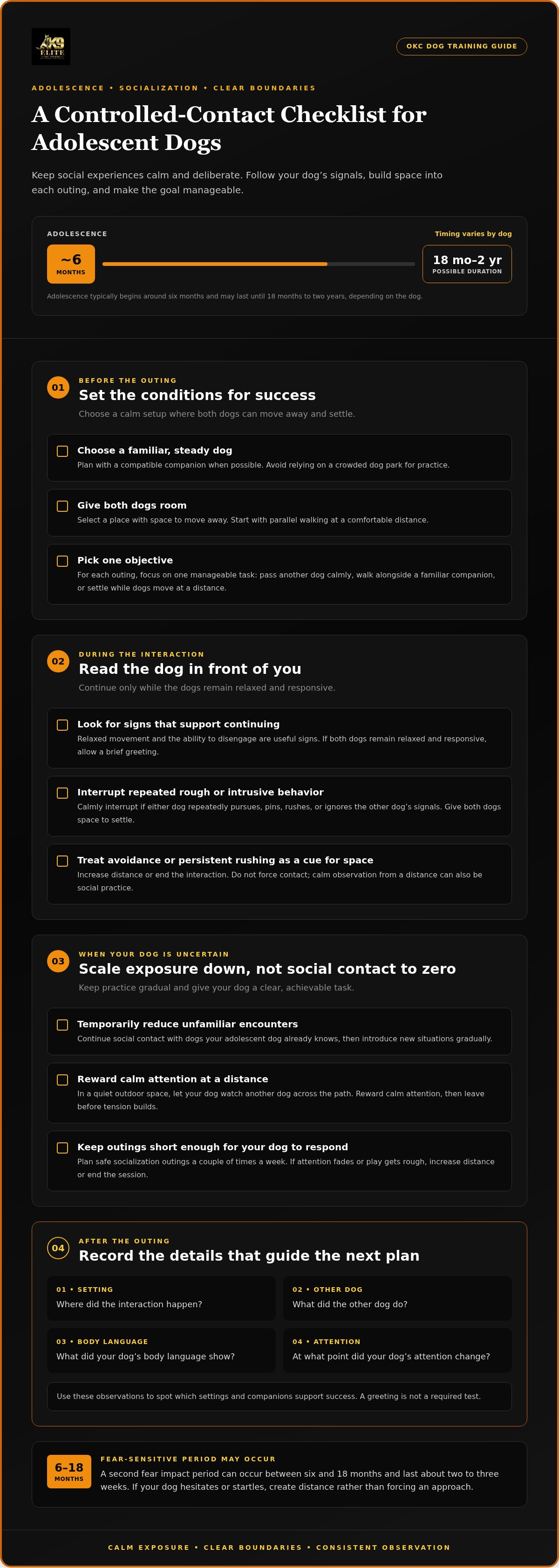
Social development continues through adolescence, so puppy experiences alone won’t prepare a dog for every later encounter. A teenage dog may crowd another dog, ignore signals to pause, or become distracted during familiar play. These moments call for guided practice, not forced interaction. Pay attention to the dog in front of you: relaxed movement and the ability to disengage support continued interaction, while persistent rushing or avoidance signal a need for more space.
Build a controlled socialization plan around familiar, steady dogs. Arrange brief meetups with compatible companions in a place with room to move away, rather than relying on a crowded dog park. Start with parallel walks at a comfortable distance, then allow a brief greeting if both dogs remain relaxed and responsive. Calmly interrupt if either dog repeatedly pursues, pins, or ignores the other’s signals. End with a manageable moment, such as both dogs returning their attention to their handlers.
If your adolescent dog seems uncertain around unfamiliar dogs, temporarily reduce those encounters without ending social contact altogether. Keep practicing with dogs they already know and introduce new situations gradually. In a quiet outdoor space, your dog might watch another dog from across the path, receive a reward for calm attention, then leave before tension builds. This gives your dog a clear task and helps prevent social exposure from becoming overwhelming.
Make each interaction purposeful. Plan safe socialization outings a couple of times a week, with age-matched peers when suitable. Give each outing one objective: calmly pass another dog, walk alongside a familiar companion, or settle while dogs move at a distance. Keep sessions short enough for your adolescent dog to respond to cues. If attention fades or play gets rough, increase distance or end the session. Consistent boundaries teach that access to play depends on manageable behavior.
After each interaction, note what happened: the location, the other dog’s behavior, your dog’s body language, and the point when attention changed. These details reveal which settings and companions support success. Avoid treating every greeting as a required test; calm observation can be valuable social practice, too. If your dog repeatedly struggles to remain composed around other dogs, structured socialization guidance can help you shape safer, more deliberate practice.
Exploration and fear or defensive behavior
An adolescent dog may suddenly hesitate at a familiar intersection, bark at someone wearing a hat, or avoid a surface they previously crossed without concern. These shifts can reflect increased sensitivity to environmental stimuli, not deliberate defiance. Record where the behavior occurred, what happened just before it, and how your dog responded. A brief log can reveal whether a particular sound, location, object, or approach repeatedly triggers fear.
A second fear impact period can occur between six and 18 months of age and last about two to three weeks. During that window, a dog might startle at a recycling bin that was previously ignored or retreat from a visitor entering the home. Don’t force the dog toward the feared object. Instead, create distance, allow observation, and reward calm investigation. If your dog chooses to move closer, let that choice guide the next step.
Use exploration as a controlled learning task. At a quiet park, pause when your dog notices a fluttering flag. Give them enough space to look, sniff, and turn away without restraint. When your dog can observe without escalating, reward them for turning their attention toward you, then move on. Repeat later from a comfortable distance. This approach gives your dog room to process new stimuli and avoids flooding, which can intensify distress or provoke escalation.
Fear can appear as freezing, hiding, a tucked posture, repeated scanning, growling, or lunging. These signals call for a different response than ordinary curiosity. For example, if your dog growls when a stranger reaches over their head, prevent further reaching and increase distance. Don’t punish the growl: it communicates discomfort, and suppressing that warning doesn’t resolve the cause. Note the trigger and how your dog recovers after the situation ends.
When behavior changes abruptly, schedule a veterinary exam before treating it solely as a training issue. Pain or another health concern can affect how your dog responds to touch, movement, or ordinary household activity. Bring specific observations, such as avoiding stairs, flinching when handled, or reacting near a food bowl. A veterinarian can assess possible medical contributors, while a behavior professional can help address learned fear or defensive responses.
Seek professional guidance when fear is persistent, interferes with daily routines, or includes aggression or compulsive behavior. In Oklahoma City, keep outings manageable by choosing quieter routes and planning an exit before exposure begins. The goal isn’t to make your dog tolerate every stimulus. It’s to build safer responses, one controlled experience at a time.
4. Impulse control and emotional regulation
Address leash pulling, jumping, chewing, and ignored cues by reducing distractions and practicing one skill at a time. Reward a loose leash, four paws on the floor, and choosing a chew toy. If your teenage dog stops responding, create distance from the trigger and return to an easier step.
During the distinct adolescent phase between six and 12 months, brain development and hormonal shifts can temporarily weaken responsiveness to familiar commands. A dog may know “come” at home but ignore it near squirrels or other dogs. That change doesn’t erase prior learning. It means the current setting may exceed the dog’s ability to focus, so adjust the difficulty and rebuild reliability in stages.
Start each practice session with a clear, achievable task. Ask your dog to sit briefly in a quiet room, reward the response, then practice near a mild distraction. If your dog breaks position, don’t repeat the cue more loudly. Increase distance, simplify the task, and reward the next correct response. This sequence helps your dog succeed while showing you which distractions make it harder to respond.
Impulse control develops through repeated choices, not constant restraint. Give your dog appropriate opportunities to make choices: let them sniff a designated patch, choose between two toys, or pause before moving through a doorway. Set the boundary first, then give a clear release cue. For example, ask your dog to wait briefly before opening the door, then release them when the leash remains slack. Predictable rules provide structure without removing every opportunity to explore.
Household routines can also reduce frustration. Before your meal, feed your adolescent dog and offer a chew or food puzzle. This gives them an appropriate task while people eat. During greetings, ask visitors to wait until your dog settles before offering attention. For chewing, keep tempting objects out of reach and make an approved chew item easy to find. Each setup helps prevent unwanted behavior from becoming a habit and clarifies the right alternative.
Keep practice brief enough to preserve attention, then gradually build duration and add distractions. A cited cognition study found better executive-function task performance at two years old than at nine weeks old. That comparison is a reason for patience with developing skills, not for dropping expectations. Track which cues hold up in each setting, then practice the weakest point at a manageable level. If basic cues or leash manners remain difficult, structured obedience training can give you and your dog a consistent plan.
5. Returning to earlier training steps
Reward-based practice, predictable routines, and gradual increases in difficulty can help with adolescent behavior challenges. Start with a cue your dog knows in a quiet room, such as “sit” before a meal. Reward the response promptly, then practice in a slightly more distracting setting. If your dog stops responding, make the task easier instead of repeating the cue or raising your voice. This approach restores clarity and shows you where your dog needs more practice.
Rebuild skills in the situations where they matter. For leash pulling, start on a quiet stretch and reward slack in the leash before adding busier surroundings. For jumping, invite a greeting when all four paws are on the floor, then pause attention if paws lift. For chewing, place suitable chew items within reach and prevent access to tempting household objects. Each setup gives your dog a clear alternative and helps prevent unwanted behavior from becoming routine.
Use short training moments throughout the day instead of relying on one long session. The SMART x 50 approach recommends noticing and rewarding 50 moments of naturally good behavior each day. For example, reward your dog for settling while you prepare food, checking in during a walk, or waiting calmly at a doorway. These small reinforcements make the behavior worth repeating. Keep a simple log of the cue, location, distraction, and response to track which skills need another step.
Move ahead only when your dog responds reliably at the current level. Change one factor at a time: increase your distance, add a mild distraction, or practice somewhere new. If your dog can wait beside the kitchen counter but struggles near the front door, return to an easier version of the exercise there. Addressing adolescent dog behavior problems in OKC starts with identifying the skill and setting that need the most attention. Avoid testing several new challenges at once. A plan based on observable progress keeps practice fair, consistent, and focused on learning.
Setbacks are useful information. If a familiar recall fails near a moving dog, increase distance and reward attention before trying the cue again. If jumping returns during a visitor’s arrival, rehearse the greeting routine without the visitor first. Keep household responses consistent so the dog receives the same boundary from each person. When repeated practice doesn’t resolve a behavior or safety concerns arise, seek tailored guidance for adolescent dog behavior problems in OKC. Request a dog training evaluation to identify the next practical training steps for your adolescent dog.
K9Elite: In-Home Evaluation
K9Elite’s In-Home Evaluation helps identify what’s driving an adolescent dog’s behavior in its everyday environment. The assessment considers the dog’s responses, household routines, behavioral triggers, and communication between dog and owner. Seeing the home setting can clarify why a cue works indoors but breaks down near the door, around visitors, or during walks.
Consider an evaluation if leash reactivity, fear, aggression, or repeated training setbacks are difficult to manage safely. The findings can guide a practical next step, such as Obedience Training for clearer responses or Behavior Modification for more complex behavior challenges. The aim is a structured plan that fits your dog and household, not a generic routine.
For a focused starting point with your adolescent dog, contact K9Elite to discuss an In-Home Evaluation.
Set the Next Training Goal
Your dog’s next step should be specific enough to practice and observe. Choose one priority, such as settling when visitors arrive or walking without pulling, and use the same cue and response across your household. Consistent handling gives your dog a clear task and helps you see whether the plan is working in everyday situations.
For adolescent dog behavior problems in OKC, K9Elite can begin with an In-Home Evaluation and help determine whether Obedience Training or Behavior Modification best fits your dog’s needs. The focus is a practical plan grounded in your home environment and the behaviors you want to change.
Take the next step at your pace. Contact K9Elite to discuss your dog and identify a clear starting point for training. Steady guidance can help you build a more reliable working relationship with your adolescent dog.
Frequently Asked Questions
Do dogs go through a rebellious stage?
Yes, some dogs become less consistent as distractions and competing motivations increase. Rather than interpreting this as deliberate defiance, identify the cue and setting where your dog’s response breaks down. For example, if your dog responds to “come” indoors but not during play, practice with a less distracting activity first. Reward the response you want, then gradually increase the challenge. This gives you a clear training target.
What if nothing is helping?
Change the plan, not just the volume or frequency of corrections. Choose one behavior to address, set up a practice situation where your dog can succeed, and ask a qualified professional to observe what happens. If the behavior is sudden or seems connected to discomfort, arrange a veterinary assessment. For safety, prevent situations that could lead to injury while you develop a structured response.
What behavior problems are common in adolescent dogs?
Common challenges often involve impulse control, frustration, fear, and difficulty responding amid distractions. The useful question is how each issue affects daily life. Note whether the behavior occurs only during greetings, around valued objects, or when a routine changes. That context can help distinguish a specific training gap from a broader pattern and guide which skill to prioritize first.
At what age do dogs enter adolescence and how long does it last?
Timing varies by breed and individual development, so there isn’t one exact age that applies to every dog. Rather than relying only on an age estimate, monitor changes in attention, confidence, and responses to familiar cues. Developmental stage can affect training consistency, but daily practice should still match your dog’s current ability and the demands of each setting.
When should adolescent dog behavior problems be evaluated by a veterinarian or behaviorist?
Seek veterinary input for sudden behavior changes, signs of discomfort, or reactions linked to touch and movement. A behavior professional can help when a recurring pattern disrupts household routines or raises a safety concern. Before an appointment, write down what happened, what preceded it, and what helped your dog recover. Specific observations are more useful than a general description such as “acting out.”
Where can I find dog trainers specializing in adolescent behavior in OKC?
In Oklahoma City, K9Elite provides in-home dog training, including Behavior Modification for behavior challenges. An in-home setting can help examine how household routines and surroundings relate to a dog’s behavior. When contacting a trainer, describe the specific situation you want to change, such as difficulty settling during a family routine or trouble responding to cues in a particular setting. That gives the discussion a clear starting point.
What Oklahoma City dog training classes or private behavior consultations are available?
K9Elite offers Group Classes and private in-home options, including In-Home Evaluation and Behavior Modification. Group Classes provide a setting for practicing obedience with guidance, while private consultation can focus on a behavior concern in the dog’s home environment. Think about whether your main goal is general skill-building or support with a particular behavior pattern, then choose the format that best matches that objective.
What low-cost dog training resources are available in Oklahoma City?
Start at home by practicing familiar cues during daily routines and rewarding calm choices with praise or your dog’s regular food. Short, simple activities and predictable routines provide structure without added expense.
Comments